The Surfeit and the Wound: On Pleasure
A lost city of erotic temples, a king's gold salt cellar, a painter's last unhealing canvas: what the West did with pleasure once it stopped serving God, and what pleasure still asks of anyone who looks.
13 min read
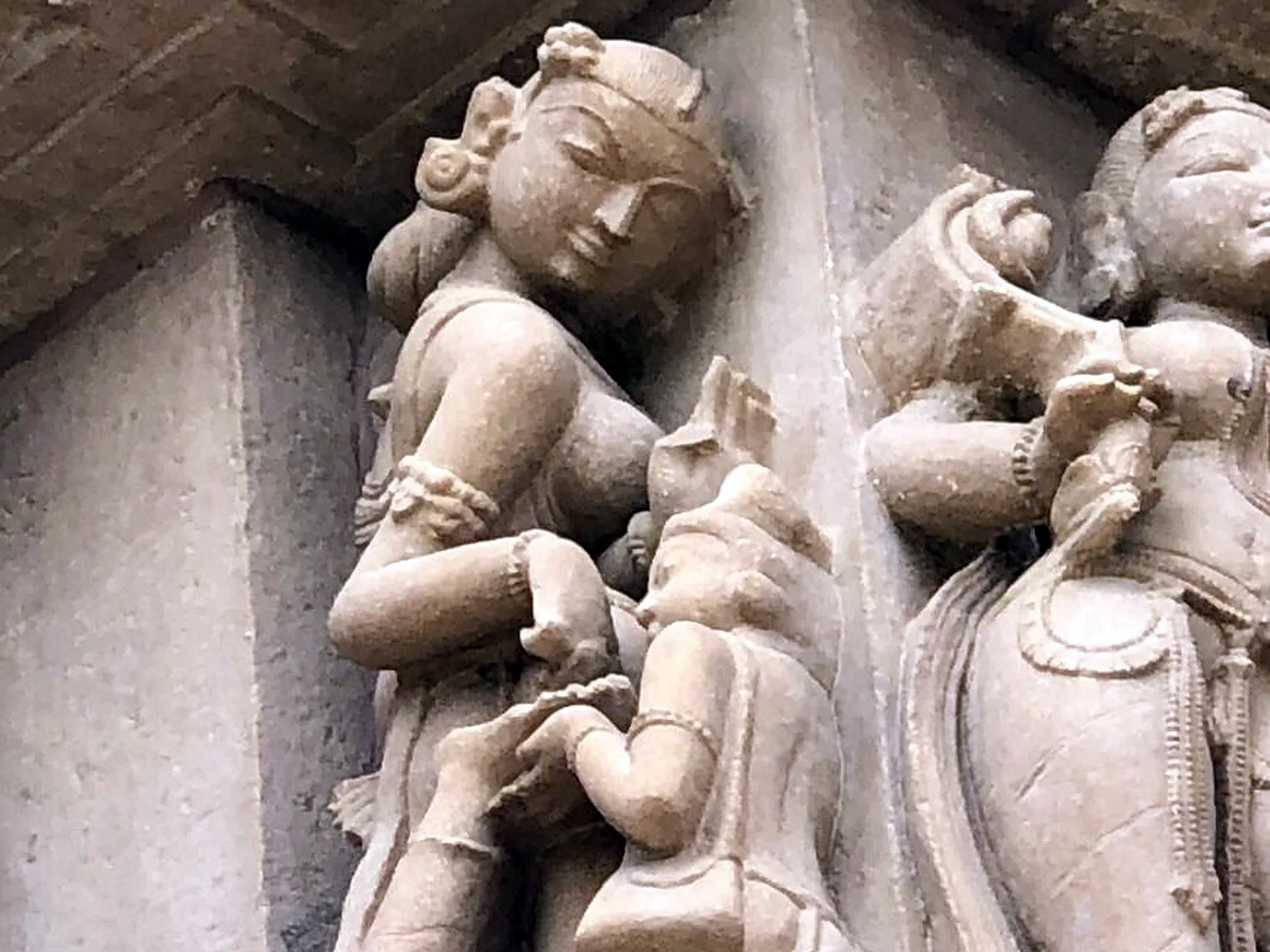
Erotic relief carvings, exterior wall, Lakshmana Temple, Khajuraho, c. 954 CE. Sandstone. The temples raised by the Chandella dynasty between 950 and 1050 cover their exterior surfaces with figural carving in which sacred and erotic iconography share the same stone.
In 1838, a British engineer named T.S. Burt stumbled across ruins in central India that had stood unattended beneath the languid arms of the surrounding jungle for five hundred years. Like some Eldorado, the place had been preserved by the very forest that hid it; the jungle had earlier acted as deterrence to the foreign invaders who had taken everything else. The site was Khajuraho. It took more than a century after Burt's accidental rediscovery for the temples' true significance to be recognised.
Eighty-five temples had been raised here between 950 and 1050 by the Chandella dynasty, one of the most prominent regional powers of the tenth to thirteenth centuries; about a quarter survived. It had been the scene of a cultural flowering comparable to Knossos in Crete between 1600 and 1400 BC, or to Florence in the Renaissance, which, in its density and extent, remains mysteriously unaccountable. Khajuraho is a place concealing several deep spiritual strata: there had earlier been Buddhist settlements there, and the different sects of Shaiva, Vaishnava, and Jain shrines coexist on the site, attesting to the Chandellas' religious tolerance. As abruptly as it began, Khajuraho toppled in 1203, and by 1309 the Delhi Sultan Alauddin Khilji had all but eradicated any Chandellian trace.
Burt would have seen the masonry first; so does anyone standing in front of it now. The temples are festooned with intricate carving, the most lasting impression being the explicit erotic content covering many of their surfaces: a writhing, serpentine mass of strong, confident forms, many of them engaged in ravishing, carnal pleasure. Gothic cathedrals may have their share of incidental irreverencies, but there is nothing in Western architecture or sculpture to match the ribaldry and sensuality of these carvings.
A woman with full thighs and breasts rotund enough to make any cosmetic surgeon's pupils dilate decorates her eyes; diminutive figures stand in attendance while in the neighbouring recesses writhe panther-like forms, flanked by smaller beings, crouching and twisted. Elsewhere Siva fondles a woman's breast whose body is bent to fit snugly into the arc of his. Each encounter is topped and bottomed with foliage and decoration. Just looking at these buildings leaves a feeling of surfeited physical indulgence.
Three explanations are usually given for the erotica. The first concerns the genesis of the place. A daughter of a Brahmin priest was seduced by the moon god while bathing one evening; she bore a son, Chandravarman, but, because her demigod status incited vilification, sought refuge in the forest. After her son became the first ruler of the Chandellas, he received a visitation from his dead mother who charged him with building shrines devoted to the human passions, the intention being to reveal the vanity and transience of human desire. The second is more pedagogical: the carvings were made to instruct the boys bound to the law of the brahmacharis about the human passions before they could graduate to the role of householder. The third places the temples within the Tantric tradition, a belief that promises attainment of the infinite through the disciplined and exhaustive satisfaction of earthly desire.
That the West produced nothing to compare with this is not just because it never invented anything like Tantrism. It has to do with the Neoplatonist values dominant from the fall of the Roman Empire to the Italian Renaissance. Taking its cue from Plato, the Neoplatonist view points to the world as the appearance of things. The great Neoplatonist Plotinus, who lived from 204 to 270 and was influenced by Aristotle in several branches of his thought, did not condone the pleasures of the body, which were to be subordinated to the gratification of the spirit. In the section on happiness in the Enneads, Plotinus warns against distractions from the development of the intellect. He rejects the hedonism espoused by Socrates' contemporary Aristippus, and equally the ideas of Epicurus, who advised that we must always attend to satisfying our senses since they are components of our being. To Plotinus, happiness is related to the Good, which on this mortal earth is but the image of the higher Good; sensations are worth nothing without reason and authentic intellection, and without those no perfect life can be realised. The body is full of sensory fluctuations; the mind's aim is for constancy. The remedy, Plotinus concludes, is to strip away the body and its life of sensation, the only way to secure the self-enclosed unity that happiness needs.
What we are presented with on the subject of pleasure is therefore either to surrender to the fruits of bodily desire, or to sublimate the sensuous world. To take the latter course too literally is to suspect sensual material as wicked and distracting, as we find with the fundamentalist religions. It is also for this reason that some religions have and do treat art with suspicion. The Khajuraho carvings refuse the choice.
The West had its own counter-position to Plotinus, and an older one, in the tenth book of Aristotle's Nicomachean Ethics, where the argument runs that all men seek pleasure because all desire life, that life is a form of activity, and that the pleasure supervening on an activity perfects it and so perfects the life all of us want to keep. Whether we desire life for the sake of pleasure or pleasure for the sake of life, Aristotle dismisses for the moment; the two are too intimately bound to admit of separation. Every activity, he says, is crowned by pleasure, and there is no pleasure without some activity. The musician does not attend to the sounds in order to feel the pleasure; the pleasure is what attending well throws off. The carvings at Khajuraho can be understood within this frame without modification: the carnality crowns the devotion the way activity well conducted is crowned by its pleasure.
Pleasure is what we receive from the work, whilst beauty is a quality of it. Beauty can be a sensuous, physical phenomenon, or it can be an idea. A work of art may look commonplace or ugly at first, until it works upon the sensibility and the understanding, which finally accepts it as beautiful. Art has always had a troubled relation with the decorative, the quality of beauty that announces itself out of hand. Decorative beauty asks for nothing in return. Art's pleasure is different; it poses tantalising questions about how pleasure might be achieved and maintained.
Alois Riegl held, in his introduction to A Historical Grammar of the Visual Arts, that visual art evolves by the same force as every other human enterprise, a Weltanschauung, a world-view answering to the need for happiness. Happiness is the extension of pleasure, and pleasure that crowns activity is the form of happiness Aristotle described. If the pleasure we get from art were reducible to gratifying one or more of our senses, we would not be concerned with it the way we are; it would join the ranks of eating or copulating.
When we see a work that represents pleasure, we perceive the suspension of that state and a promise that we can perhaps achieve it. When we are glad to experience a stimulated displeasure in the work of art, we may feel a relief in encountering a pleasure not betokened by society's mores, or the work may rupture the status quo to open an alternative for a better state of affairs. What compels people to art is the pleasure taken in being challenged, the pleasure of being stimulated, and, at the extreme, the pleasure that comes from how the work satisfies the instinct for displeasure. Pleasure is always somewhere in the work of art.
In Modernism, pleasure and especially beauty are treated with particular philosophic interest, as something belonging to human awareness as distinct from belonging to a deity. Once humans took active responsibility for their own thought, the meaning and apprehension of beauty was cast in a different light, as were the uses of pleasure. If art no longer serves a higher power, what function does it serve? The answer is inconclusive, except to accept that the pleasures are in the making, the seeing, and the thinking. In the main, art represents a higher form of living, either in what it conjures or in what it aims to dispel, or in what it brings to those who give it the time.
There is the pleasure of being shown a thing, of spectacle, of having one's attention occupied for you, and these are passive pleasures, available with no work asked. The pleasures of the making, the seeing, and the thinking have to be worked for. They require the activity of which they are the consequence; the painter takes them in the act of painting, the viewer in the act of looking. This is what separates it from entertainment, where the pleasure comes free of the activity.
Art occasioned by pleasure alone, as opposed to pleasure that arrives through ritual or through the service of religious instruction, comes into force in the West only by the middle of the sixteenth century. The period is associated with a fair amount of discord, reflected in the tensions and compositional imbalances of the works that gave their name to Mannerism. Bodies become elongated and contorted; the harmonies of the kind found in Raphael and Perugino loosen. The year 1527 had a singular effect on Italy and the rest of Europe, in that Rome was brutally sacked by the troops of Charles V, who ravaged the city and imprisoned the Pope, Clement VII. The bitter effect of the pope's fall was to throw his probity into doubt, the very unimpeachability that popes such as Julius II and Leo X had laboured since the end of the fourteenth century to resolder. The rape of Rome is a convenient marker for the close of the Renaissance and the opening of a new period of uncertainty, the age of doubt, Montaigne born in 1533 and Descartes in 1596, four years after Montaigne's death, the whole stretch blighted by two centuries of conflict between Catholics and Protestants.
Michelangelo's Last Judgment of 1536 to 1541, commissioned by Pope Clement VII shortly before his death in 1534, is the manifesto work of this period, a work that combines faith with doubt, for the beneficence of God is depicted entirely through terror. The body, once subordinated to a higher state, has become one. All the calm of religious equilibrium is sacrificed in favour of bodies contorted and gyrating in the throes of their retribution.
Despite the dilemmas of faith, or perhaps because of them, the mid-sixteenth century witnessed an outpouring of works that celebrated the marvellous, the indirect consolation, as Romanticism was later to prove, of an increasingly confusing and enlarging universe. With the adoption of gunfire in warfare and duelling, weaponry became a constant resource for artists' revenue. The smaller works carried the change: statuettes, table settings, pistols, sword pommels, the gold and gem and ivory objects that the growing availability of materials through naval trade made possible. Secular culture, as we know in our overly consumerist culture, is one that seeks satisfaction in the material world and in the feats of its own ingenuity. Anyone with an interest in art and a dislike of war should suspend the aversion and visit an exhibit of historic weaponry from the sixteenth and seventeenth centuries, where some of the most astonishing examples of intricate decoration anywhere are to be found. A sporting rifle from Saxony in the early 1600s is adorned with images of the hunt in a filigree of brass, with fruitwood, horn, and mother-of-pearl inlay, the kind of object the gentry prized and gave to honoured guests before the hunt.
By the end of the Renaissance, sculptors had to be skilled metalworkers as well as carvers and clay modellers. The Flemish-born Florentine Giovanni Bologna, known as Giambologna, is credited with being the first artist since antiquity to make his career from secular as opposed to sacred works. His work, together with that of Cellini, signals a conclusive change, already staged in Renaissance works that incorporated classical mythology, toward a sumptuousness whose limits are never too great.
A memorable example is Cellini's Saliera of 1540 to 1543, the salt cellar commissioned by François I. It is his only known work in gold, and the table-setting allegory is not concerned with culinary delights as might be expected, but with the whole world. The sea is depicted as a man and the earth, predictably, a woman; at the base are the four winds, the times of day, and general human activity. Think of this gorgeous relic next time you salt your potatoes.
Then there are the pleasures of love, and the pleasures of sharing the fruits of the earth. Two works from roughly the same time in the early seventeenth century celebrate these things, Velázquez's Feast of Bacchus of 1628 and Rembrandt's Artemisia of 1634.
Painted under the spell of Rubens, Velázquez elaborates on the high realism of his earlier Seville bodegones, his still-life works, for an image that combines pageantry with the common man savouring common things. The picture comes with a number of interpretations: that the semi-nude figure to the left is a false Bacchus; that the scene depicts Bacchus paying a visit to mortals to present them with the gift of wine. Whether Velázquez handles his subject with the same assurance as his later works is open to debate, but what is undeniable is that the image celebrates the efforts of mere humans to partake in worldly experiences that, all too briefly, give them a taste of higher things. It is also about bountiful charity: giving abundance to the poor, Bacchus the spreader of miracles discovered in the mixed blessing of inebriation.
With Velázquez one always needs to look closely at the paint handling, masterfully controlled, whilst always responsive to its physical lusciousness. From the startlingly clear glint of the glass at Bacchus's feet to the heavy folds of the brown blanket on the right, this is a work of an artist whose discipline never eclipses the joy in what he does. The pleasure of paint is the pleasure of activity well conducted: the brush attending to the glass, then to the heavy wool, then to the inebriated faces of men whose pleasures the painting honours by giving them this much patience.
Rembrandt's Artemisia comes from the artist's earlier period, when he was more materially prosperous and when his paintings betray an optimism that would later be replaced by introspection and melancholy. Artemisia, queen of Caria, receives the cup containing the ashes of her loved husband, Mausolus. It is a painting exuding the fullest love with the least mawkishness and greatest frankness. Executed in the same year as his marriage to Saskia van Uylenburgh, there is no doubting the artist's sincerity, for whom the glowing gold figure of Artemisia seems to exude light.
Much like Rembrandt, Goya was exuberant in youth and sombre in old age. The Flower Girls of 1786 and 1787, painted for the royal dining room of the El Pardo Palace, is characteristic of the artist's positivity that reigned until the death of Carlos III. It stands out for its absence of any negativity while avoiding triviality, and it has a lightness that comes from relaxed comfort and happiness. This kind of work was also popular in France, though there candied with greater hedonism and provocative sensuality, the eighteenth century that writers such as the Goncourt brothers would later look back on as an age of lost joy.
Goya's later paintings, such as his gathering of crones in the Witches' Sabbath of 1821 to 1823, a work drained of any happiness or redemption, and his brooding etchings, register a distinct fall from grace. It is as if the artist nurses a deep, unhealing wound.
The wound is where Aristotle's frame meets its limit. The activity has not slackened; Goya is still painting at full stretch. By the frame's logic, the pleasure should follow. It does not. The crowning depends on a condition Aristotle never had to state, because for him it was a given: that the world the activity is conducted in is itself worth the activity. The hand had not failed. The world it worked in had, and the wound is what is left on the canvas.
The Khajuraho panel is still there. Two figures in carnal proximity, foliage above and below, smaller bodies in attendance, a particular curve where one body fits another. The pleasure on the surface of the stone is not divided from the spiritual claim the temple makes. Tantric practice held that the infinite could be approached through the disciplined and exhaustive satisfaction of earthly desire; the carving is what that claim looks like when it is made in masonry. The moon god and the Brahmin's daughter, the boys readied for the householder's role, the Tantric route to the infinite through the body: all of it rests on the same surface.
T.S. Burt arrived in 1838. The carvings had been there for nearly eight hundred years.
· · ·
References
Aristotle, Nicomachean Ethics, Book X, in The Ethics of Aristotle, trans. J. A. K. Thomson, revised by Hugh Tredennick, Harmondsworth: Penguin, 1976.
Plotinus, The Enneads, trans. Stephen MacKenna, abridged edition, London: Faber and Faber, 1956.
Erotic relief carvings, exterior walls, Kandariya Mahadeva Temple, Khajuraho, c. 1025-1050. Sandstone. Archaeological Survey of India.
Erotic relief carvings, exterior walls, Lakshmana Temple, Khajuraho, c. 954 CE. Sandstone. Archaeological Survey of India.
Francisco de Goya (1746-1828), Witches' Sabbath (El Aquelarre del Cabrón), 1821-1823. Oil on plaster transferred to canvas. Museo del Prado, Madrid.
Francisco de Goya (1746-1828), The Flower Girls (Las floreras, or La primavera, Spring), 1786-1787. Oil on canvas. Museo del Prado, Madrid.
Alois Riegl, Historische Grammatik der bildenden Künste (1898), trans. as Historical Grammar of the Visual Arts, ed. Karl M. Swoboda and Otto Pächt, trans. Jacqueline E. Jung, New York: Zone Books, 2004.
Diego Velázquez (1599-1660), The Feast of Bacchus (Los borrachos), 1628-1629. Oil on canvas. Museo del Prado, Madrid.
Michelangelo Buonarroti (1475-1564), Last Judgment, 1536-1541. Fresco. Sistine Chapel, Vatican City.
Benvenuto Cellini (1500-1571), Saliera (Salt Cellar), 1540-1543. Gold, partly enamelled, with ebony base. Kunsthistorisches Museum, Vienna.
Rembrandt van Rijn (1606-1669), Artemisia, 1634. Oil on canvas. Museo del Prado, Madrid.
