The Worn Body: Porn, Sex, Dolls and the Natrificial
From Orlan's operating theatre to the spornosexual's expressionless face, by way of the breast implant and the bodybuilder's stage,
12 min read
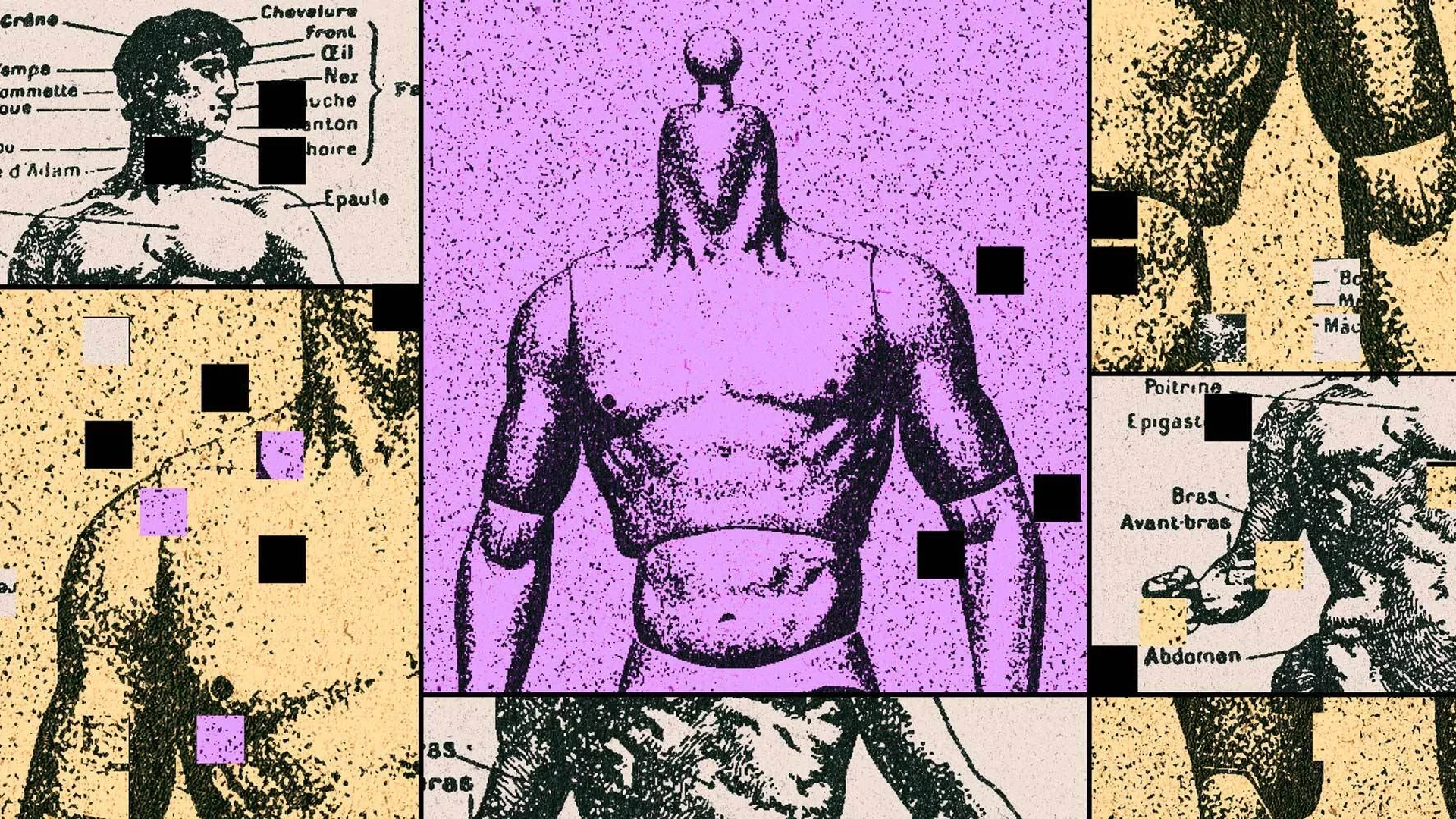
The male body as diagram: a collage of vintage French anatomical illustrations, labelled by part, arranged under clinical scrutiny. The body here is neither the nude nor the natrificial ideal; it is inventory.
Begin with the arrangement. In a great deal of straight pornography the man lies down, though behind, and the woman, also lying down, raises one leg, so that the act of penetration is turned out toward the camera at the cost of any posture a body would assume for pleasure or for love. The pose has no private precedent. No one lies like this for another person; the limbs are cantilevered into a configuration whose only logic is visibility, held for the duration of the shot and abandoned the moment the lens looks away. Note the ungainly poses of straight porn, struck so as to reveal all for the camera: to do so the body must be torqued out of every position it would otherwise seek, and what one is left watching is the body as marionette, angled and sustained by a hand outside the frame. The hand is the camera, and behind the camera the accumulated expectation that tells the body where to go. Strung up in this fashion the figure is already half a doll, hinged where a person bends.
Call the condition the natrificial, the natural and the artificial driven into a single word because the pornographic body insists on both at once and will surrender neither. It is offered as nature, as the most natural thing in the world, bodies doing what bodies are for, and it is, in every particular, manufactured, lit and depilated and surgically revised. This is the paradox of natrificiality: it announces its contrivance as a given; the pornographic image recognises itself always already as surrogate. There is a discernible porn body that is as much worn as possessed. To possess a body is to be it; wearing one means standing a little apart from it, handling it as material to be cut and fitted. The porn body lives permanently at that remove, regarded by the person who owns it with the same appraising eye the viewer will later bring to it.
Another key aspect of natrificiality is that it is not played out only on the surface but in the way in which the body moves. The body is therefore not only the site of technology, the place where the work is done, but performs technologically. Every gesture is pre-shaped to the requirements of the shot, the angle of approach governed by the camera, so that even the appearance of spontaneity is an effect rehearsed into place. Further, the woman is more often than not wearing a garment that has been lowered at the top and hiked at the bottom. Thus to dress up as the porn actor is to anticipate the state of semi-undress. The intimate is made specular, and the body mimics, or becomes, the clown of technology, delimiting coupling and love to a genital act.
That the surface and its movements could be read this way was understood, before the industry had quite finished assembling itself, by a performance artist who turned the operating theatre into a studio. Through the early 1990s the French artist Orlan submitted herself to a sequence of cosmetic surgeries staged and filmed as artworks. She did not go under to be improved. The features she asked the surgeons to give her were lifted from canonical paintings, the forehead of Leonardo's Mona Lisa, the chin of a Botticelli Venus, the nose of a School of Fontainebleau Diana, the mouth of Boucher's Europa, chosen for the stories attached to them and not for their beauty, so that the assembled face was an argument before it was anything else. She stayed conscious throughout, under local anaesthetic, reading aloud from psychoanalysis and philosophy while her face was opened and worked, directing the room. The theatre was dressed for it: the surgeons in couture, the drapes and instruments arranged as a set, the whole transmitted live by satellite to galleries where audiences watched the cutting as it happened and sent their questions back to the table. In the most notorious of the operations she had implants of the kind intended for cheekbones placed instead at her temples, two small protrusions left deliberately as bumps, a refusal of the very symmetry the borrowed features were meant to confer. Afterward, through the long bruised swelling of the recovery, she photographed herself; and she kept what the surgery took out, sealing fat and blood into reliquaries to be shown and sold. The cutting was the artwork. The flesh it used was almost incidental, and so, in the end, was she.
Barbara Rose, writing about Orlan in 1993, made an observation about her medium that travels:
Orlan's medium, finally, is media, and if that sounds redundant, she means it to be. Her critical method is based on a sophisticated feedback system, a vicious circle of echoing and self-generating images, spawning a progeny of hybrid media production. This continuous feedback loop is difficult to escape long enough to gain sufficient distance to decode the meaning of her performances and their afterlife as documents, relics and replicated image banks.
What the feedback system finally describes is an image that has come loose from any prior reality and answers only to other images. Pornography is the largest such system ever assembled. Each image is made in the knowledge of the thousands that preceded it and the thousands it will join, and the body inside the image is shaped to that knowledge before it is shaped to anything else. Although not intended to be read this way, her words can be insightfully applied to contemporary pornography, pornography in the age of the Internet. And in this light we can also safely say that Orlan's work is highly pornographic. Here pornography has to be taken in its less literal sense, to mean a feckless playing-up to salacious voyeurism, where there is no shame or inhibition. It is also a cheapening of things, their reductio ad absurdum, a displacement of intimacy by parading it in the public realm. In doing so Orlan in effect confronted pornography with the pornographic, achieved through the spectacle of monstrous femininity. As Kate Ince argues, this is precisely what is not permitted in the male imaginary, because it is not a viable prospect of the male gaze. But in broadcasting the belly-churning ugliness leading to the pursuit of greater beauty she was confronting the male imaginary with its own abjected content. The gaze of anticipation and desire was also confronted with all the repressed conditions of the object of desire.
What Orlan saw early, the industry then manufactured at scale. Contemporary with her performances was the growth of the Internet pornography industry, an industry that is now immeasurably large, although conservative lobby groups may have had a hand in the public hysteria caused by overinflated estimates. The numbers have been contested for as long as there have been numbers, swollen by the firms selling the software to filter it and the pressure groups behind them, parties with every reason to inflate and a long habit of doing so. This explosion (most figures of speech become infelicitous when discussing matters such as these) had numerous effects, one of which was to make a certain default narrative sequence discernible, and the other was to perpetuate certain expectations about the body. The sequence is recognisable precisely because it has shed everything particular, a fixed order of positions and progressions repeated until a viewer can anticipate each turn before it arrives, and anticipation satisfied on cue is its own small reward. What gets learned here is the choreography of desire more than desire itself, and the viewer is schooled in it as thoroughly as the performer. There are many alternative kinds of pornography, but, as alternatives, these only serve to enforce the rule. Through dint of sheer quantity, what becomes evident is that the convention for the porn body is that women follow a roughly Barbie-like model and men somewhere between Ken and the bodybuilder. The dolls were in the template from the start; the industry merely cast for them.
The convergence was not metaphorical. But as the body culture accelerated in the 1980s, so did the pornography industry, and the two worlds were never too far away from one another. The bodybuilder is the clearest case of the body produced as its own end. In the weeks before a contest the work turns him camera-ready and useless at once: the water drained out until the skin shrinks onto the muscle, the colour sprayed on, the whole oiled and lit and turned through a fixed order of mandatory poses under a stage light, a figure built for nothing but to be looked at. If one way for bodybuilders to earn a living was as a personal trainer, another was pornography. Note too the interrelationship between a bodybuilder's work and that of the pornography: one labours without any palpable result except that the commodity becomes himself, while the other performs an act whose biological trajectory is to reproduce the species, but where no reproduction takes place, and instead the corporeal, carnal act becomes commodified. In each case the human arrives at the end of the production line as the thing produced, the bodybuilder under the lights already a figurine cast at life size, the doll the industry would later go looking for half-built in advance.
The sexual permissiveness of the 1960s, and the birth of pornographic brands such as Hustler (1974) and Playboy (1953), signalled a significant break with the pornography of the previous era. This was a new theatricality in which quasi-celebrities like John Holmes and later Anna Nicole Smith played a part. As pornography became increasingly stylised and the body types more fixed, the travesty and sham within the pornographic representation is there for all to see. So the natrificial enshrines two factors within straight porn over the Internet: the first is its rejection of naturalness, as opposed to, say, the verisimilitude of the filmic love scene, and second, the looks and body types it prefers. Dress fetishes persist, but these exist together with a porn body. In contradistinction to the actress who may or may not have had the attributes the gazer is looking for, the porn body imposes itself onto the viewer to achieve what the viewer cannot without the experience, the assistance, of the pornographic representation.
It is also one of the ironies within historical symmetries that the first saline breast implant was introduced in France in 1964, while the silicone prosthetic breast was invented in America in 1961, which is only just before the beginning of the new genre of porn star. Another significant stage in the manipulated body image is at the end of the 1980s, which witnessed a highly sexualised and busty feminine ideal, around the time of the bra's centenary, 1989. A little after arrives the fashion for washboard stomachs, the so-called six packs, and bulging pectorals, disseminated by the likes of Calvin Klein and their highly successful black and white underwear advertisements. No one did more to put the look into general circulation. In 1982 a photograph by Bruce Weber of the pole-vaulter Tom Hintnaus, stripped to white briefs against a whitewashed wall, went up over Times Square and made the male torso, at that scale and for the first time, a thing to be looked at the way a woman's body had long been looked at. A decade on, the campaign put the rapper Mark Wahlberg in the same briefs with a hand at the waistband, and the male body had been brought onto the same market as the female, and onto the same operating table.
What the natrificiality of straight porn exposes is a condition that in natural, non-pornographic sexual relations is always repressed, namely that we clothe the other with our needs, desires, and expectations. In ordinary intimacy the projection is mutual and goes mostly unspoken; pornography withdraws the discretion and prints the projection on the skin, so that what was once tact becomes specification. Natrificiality is the space of fantasy, desire, and lack grafted on the body in an exaggerated way, where tattoos, body modification, cosmetic surgery, athletic work, make-up, shoes, and other fetishes become one. The paradox of the worn body of porn is that it is at an extreme pole to the classical nude, but much in the manner of the political horseshoe, the two curving round until they almost touch. The classical nude is uninhibited and in its beauty suggests harmony between humanity and nature, whilst pornographic nakedness presents a kind of orchestrated violence that is not natural but rather all about artificiality and exaggeration, celebrated through the ritualised repetition of the conventionalised professional straight porn sequence. This repetition engenders a rhetorical naturalness that rivals, and undermines, the natural sexual act.
The overwhelming quantity, together with the repetitive presence of certain conventions in bodies and activities, has percolated down into fashion culture, with the now mainstream currency of terms like pornification, pornochic, and pornostyle. These designations refer to the interrelation of body and dress, but more recently similar categorisations have devolved to the body alone. In March 2015 the German national newspaper Die Welt announced a new type of man, categorised by his resemblance to the pornographic model, thus confirming the latter as a somewhat autonomous and universally recognisable type. The word had been coined the year before by Mark Simpson, who two decades earlier had given us the metrosexual. He is the spornosexual, a hybrid of the athlete and the porn star. He is the successor of the metrosexual, or rather the updated model. The spornosexual is an athlete like David Beckham but with more pronounced bulges; one of the posterboy pundits of this new genus is the Munich-based designer Philipp Plein, who uses models with minimal fat, a narrow waist, pronounced pectorals and shoulders, with closely cropped hair and an expressionless face, reminiscent of G.I. Joe, but more angular. Set a row of them together and the casting reads as a production run, the models turned out to a single tolerance, interchangeable where they stand. Plein sports a similar build, although he himself does smile from time to time. It is also not uncommon for such models, like Plein himself, to have tattoos. Unsurprisingly this look has little to do with real, outdoor, participatory sport, but the combination of sport and porn is rather obvious, since in both cases it is about function and aesthetics.
The Apollo at rest in his marble and the spornosexual lacquered under studio light are not, across the centuries between them, as far apart as they look. The single difference that counts is that the older body keeps its means out of sight and the newer one cannot, or will not: it performs its naturalness so hard that the performance surfaces, the hand beyond the frame, the wire at the wrist and the knee. What the natrificial finally arrives at is the doll, the worn body taken to its limit. A doll is all surface and no interior. It is jointed where a person bends, dressed and posed by a hand that is not its own, and built for one purpose only, to be looked at while passing for alive. The Barbie and the Ken were in the template from the start, the bodybuilder cast himself in their image, and Plein turns the finished article out by the row. Strung up to reveal everything, worked from outside the frame, the body in the pornographic image is the last and most insistent of them, the doll that swears, against every visible string, that it is the most natural thing in the world.
· · ·
References
Barbara Rose, 'Is it Art? Orlan and the Transgressive Act', Art in America, 81.2, February 1993, 125.
Kate Ince, Orlan: Millennial Female, Oxford and New York: Berg, 2000.
Marianne Thesander, The Feminine Ideal (1994), trans. Nicholas Hills, London: Reaktion, 1997, 218.
Mark Simpson, 'The Metrosexual is Dead. Long Live the Spornosexual', The Daily Telegraph, 10 June 2014.
Susanna Paasonen, Kaarina Nikunen, and Laura Saarenmaa (eds.), Pornification: Sex and Sexuality in Media Culture, Oxford and New York: Berg, 2007.
Mark Simpson, 'Here Come the Mirror Men', The Independent, 15 November 1994.
Adriano Sack, 'Was Will der spornosexuelle Mann?', Die Welt, 2 March 2015.
Samuel Wilson Fussell, Muscle: Confessions of an Unlikely Bodybuilder, New York: Poseidon Press, 1991.
Calvin Klein underwear campaign, photograph by Bruce Weber of Tom Hintnaus, 1982; campaign featuring Mark Wahlberg, 1992.
Pamela Church Gibson, 'Pornostyle: Sexualized Dress and the Fracturing of Feminism', Fashion Theory: The Journal of Dress, Body and Culture, 18.2, 2014, 189 to 202.
Annette Lynch, Porn Chic: Exploring the Contours of Raunch Eroticism, London: Berg, 2012.
After Praxiteles, Aphrodite of Knidos, c.350 BCE. Marble. Vatican Museums, Rome.
