Dying in Fancy Dress: The Psychology of Cosplay
A murder at carnival, a Mannerist stage, a contract that hands a manga character ownership of herself: the costume has always been a way of dying into someone else. What the convention floor inherited from the masquerade ball.
26 min read
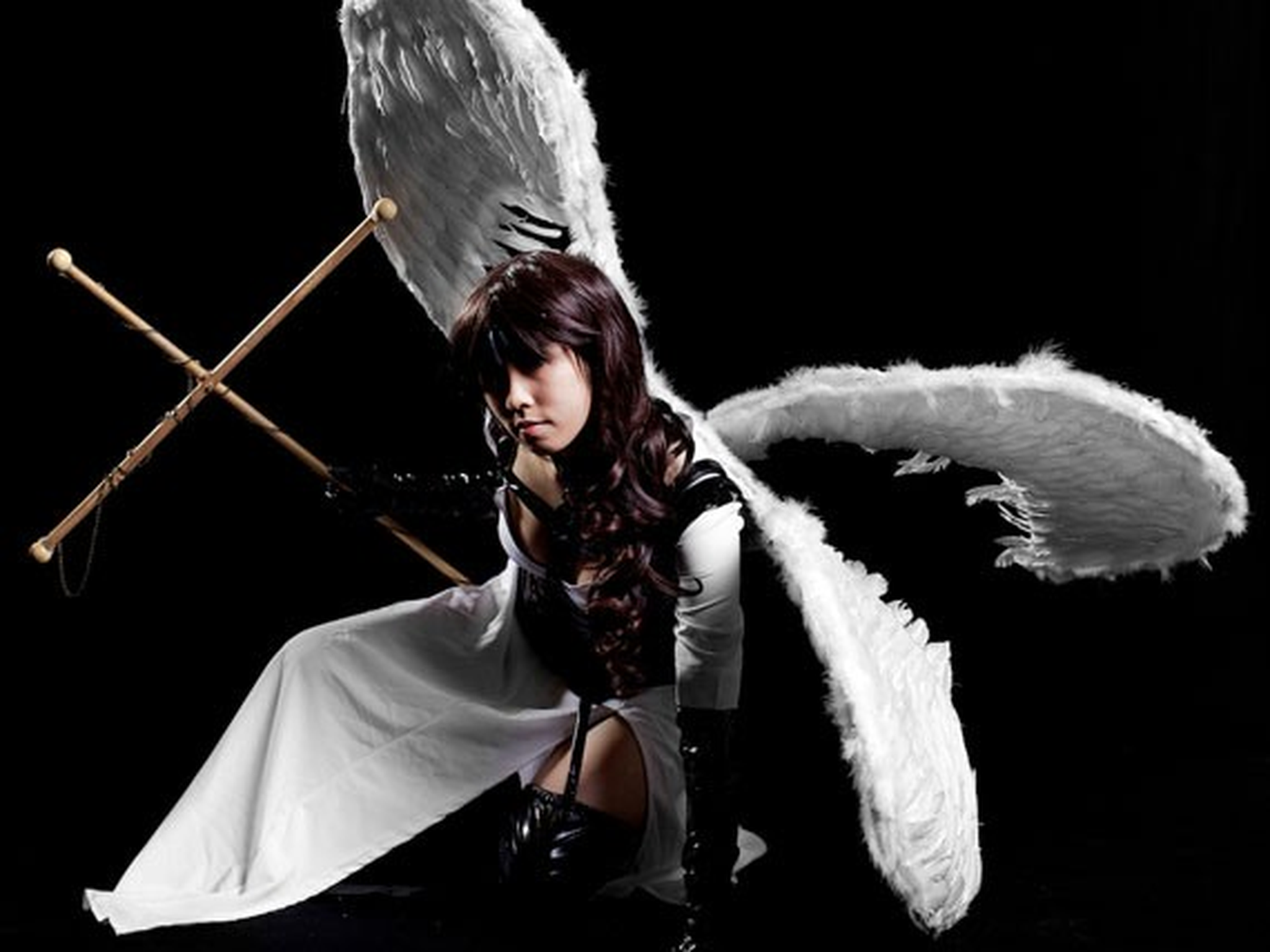
Winner, Best Overall and Best Role-Playing/Performance (Solo). Portrait by Adam Sebastian West. Exhibited in conjunction with QAGOMA's cosplay programme, Brisbane. The costume constitutes the subject entirely; what is behind the surface is a matter of narratives connected to the character, not of the character's psychology.
One of the most memorable of Edgar Allan Poe's chilling tales, "The Cask of Amontillado", opens during what its narrator calls the supreme madness of the carnival season. He tells of an unnamed betrayal at the hands of a friend, which he means to address. His rival, unaware of the narrator's machinations, meets him with excessive warmth, for he had been drinking too much. The man wore motley. He had a tight-fitting, parti-striped dress, and his head was surmounted with a conical cap with bells. So dressed, the narrator lures his friend, Fortunato, deep into a cellar with the promise of sharing an especially rare and delicious bottle of Amontillado. On the way down Fortunato is seized with a cough, for which the narrator offers a draught of Medoc. Revived, the wine sparkling in his eyes and the bells jingling, he makes a series of grotesque gestures meant to signify his belonging to a masonic brotherhood. When Fortunato questions the narrator's own belonging, the narrator produces a trowel, meant as a masonic talisman. Passing deeper into the abyss they reach the catacombs, where the narrator entraps his friend in a niche in a crypt with a chain and a padlock, then walls up the area. After the pleading sounds subside to nothing, he obscures the new wall with the bones that piled throughout the vault.
That the murder occurs during a carnival is central to the story. On the obvious level it provides the narrator with the circumstances to carry out his plan, given the many distractions of a largely inebriated crowd. On another, less strategic and more symbolic level, the carnival has the future victim dressed up, playing someone else. It is left purposely ambiguous whether Fortunato, and the irony inherent in the name is hard to miss, comes dressed as he really is, as permanently dressed up and dissembling, or whether on this occasion the costume allows him a freer abandon to do what he would not in everyday clothes. What all these hypotheses share is that the clothes allow for a displacement of everyday conditions that then permits the staging of the extraordinary event, death. Or, alternatively, the extraordinary conditions allow ordinary things to be seen for what they really are, namely as mendacious and masked. It is the mask that allows for the disclosure of some measure of truth. But this comes at the expense of a certain self-nihilation: the revelation of the true self comes at the expense of the prospect of death.
Poe's story was written in 1846. The cultural practice it anatomises is considerably older, and the psychological dynamic it stages has not essentially changed. The mask has migrated from the masquerade ball and the carnival procession to the screen, the convention floor, and the elaborately sewn costume constructed in a bedroom over several months.
Cosplay, costume play, and the psychology underpinning it, is built on numerous levels of non-reality and disavowal. The disavowal is not meant as a reproach, as though the practice ought to be more truthful or authentic. For cosplay is a form of rebirth into a place of permanent hypothesis and delusion, except that the delusion is conscious, and played out across different fields of life, from physical presence to virtual worlds. It is a play for the posthumanist subject, since the absence of myth that one might read in the sheer quantity of available myths is a cause not for mourning but for celebration. It is through the very disavowal, the killing off of the mythic true self through an adopted myth, that the subject is permitted mobility for expression. Unlike the masquerade of the seventeenth and particularly eighteenth centuries, licentiousness is not the motive or the concern. The erotic in cosplay is either one factor among many or stretched to considerable limits. Unlike European masquerade, which was a ritual undertaken to escape everyday rules and mores, cosplay is driven by rules in which the body is seamless with image, narrative, myth, and community. Such rules are necessary once the subject has foregone the psychology of normal interiority and has literally turned him or herself inside out. The cosplay subject exists across the fabric of rules, and those rules arbitrate between the subjects and the narratives that define them. Cosplay is in many ways the realisation of the Pre-Socratics: it is a play of surfaces. The humanist self is annulled so that the skin, the shell, can enter into a solipsistic relationship in which depth is no longer a matter of subjective choice but only of the narratives attached to the character.
Such observations are not limited to cosplay. They extend to the very ways in which we perform ourselves as subjects, internal as they are to interpersonal relations, to language, and to socialisation. If cosplay is to be given a particular place within the wider topology of play-acting and masquerade, it falls under three broad headings: as continuous with traditional role-play; as a product of mass-imaging, social media, and virtual identity; and as an instance of the posthuman and the cyborg. All three have discernible, and in some cases overlapping, psychological templates. At the most fundamental level, dressing up is a double play in which the self situates itself by relating to an idea perceived as external. This is basic transference. But there is something qualitatively different about dressing up as someone who does not exist and, in the case of superheroes, cannot exist. The rituals of cosplay have erotic undertones, but these are highly encoded and held at a remove from any explicit act. This is one of the basics of the psychology of cosplay: it courts eroticism and death, but at a particular remove that introduces a post-millennial factor, the cyborg. The orgy can be undertaken clothed precisely because these figures are not human. It is a death of the original self, and that death sublimates the death of which the character, with his or her extraordinary persona or powers, is capable. In 1999, two French artists would formalise this logic in a legal document: a contract granting a manga character ownership of herself. She had no interior whatsoever, and the contract was not for that reason peculiar. The historical distance between Fortunato's carnival and that lawyer's office is the distance from masquerade to cosplay, and it is not a short distance.
· · ·
As a social practice, masquerade grew out of the Renaissance and the relaxing of religious mores, particularly the sensitivity to idolatry. It must also be seen as originating together with the distinction between public and private persona, with the public celebrations and pageants that in turn gave rise to new and challenging musical forms such as opera, brought to early maturity by Claudio Monteverdi. By roughly the middle of the sixteenth century there are the beginnings of a wholly new dramatic form, the commedia dell'arte. It is true that this highly physicalised, improvisatory theatre had antecedents in the Oscan drama of Rome, otherwise known as Atellan farce, but it differed in several distinct respects: the exaggerated and quasi-mechanised movements of many of its characters, and a relative conformity of costumes that marked out each character type. This was something more than dressing up to play at someone else. Never before had there been such stylisation of dress and character. Oscan comedy used masks, but next to nothing is known of its costumes, which were inconsequential. With the commedia, the bodily costume in a sense compensated for the obscured physiognomy.
Most importantly for this discussion, the rise of the commedia dell'arte occurs at roughly the same time as that of the modern Cartesian subject. This matters to the argument that cosplay represents a further turn in the conception of self. If Descartes introduced a break between mind and body, cosplay reintroduces the break in reverse, since the psyche is now subordinated to style, surface, and body, something already incipient in the commedia. The commedia is also a pre-eminently Mannerist phenomenon, and Mannerism, for all the disputes over the word, is broadly a turn away from the harmonies and aspirations of Renaissance art toward a more discordant aesthetic: in painting the elongation and contortion of limbs, in music the introduction of dissonance, in both an effect beguilingly other-worldly, an anti-naturalism that suggested uncertainty and a wish to escape. It emerged from upheaval. The sack of Rome in 1527, when the unpaid and mutinous imperial troops of Charles V, having lost their commander, the Duke of Bourbon, killed at the walls, drove Pope Clement VII from the Vatican and put the clergy to particular savagery, is the marker usually cited, coming as it did after Luther had already, in 1521, refused to recant before both emperor and church. The sack proved decisive in fomenting distrust, and in placing the inviolability of the church in question. Some reprieve came with the treaty of Cateau-Cambrésis between France and Spain in 1559, and it was in that relative peace, and its renewed festivity, that the commedia took the form we know.
It is worth dwelling on the commedia because it marks a particular turning point in the staging and masking of identity that can be paralleled later to cosplay. There had always been forms of dressing up, but there had hitherto been nothing so stylised. It worked as a system of universalising visual signifiers that, while originating in Italy, spread across Europe. The costume conventions were instantly identifiable according to character, Harlequin, Scaramouche, Pulcinella, and so on, each accompanied by a particular disposition to work within an improvised and highly physicalised theatrical dynamic. It is instructive that this form grew out of an era of religious and then philosophical doubt. The carnival of the middle ages and Renaissance, the kind famously described and analysed by Mikhail Bakhtin in Rabelais and His World, is festive and convulsively chaotic. The commedia, for all its own festive bawdiness, was an institutionalisation of masquerade, a dressing-up with a pre-emptive structure and a set of rules.
That it coincided with the early modern subject is no mistake. Dressing up was compensation for that subject's horror vacui, but also the way in which its subjective excess sought containment and some relational logic with other selves. In his analysis of the birth of the commedia in relation to Mannerism, Paul Castagno relates the hallmarks shared by both art and theatre: the typification of form, the focus on surface and excessive ornamentation, the lack of depth, the exaggeration and distortion, the emphasis on parts over the unity of the whole. He goes on to observe that the commedia is an early progenitor of modernist art, in which the relation between form and representation grows increasingly tenuous. In his classic study of Mannerism, Arnold Hauser explains that all things presented themselves in distorted forms, under a cloak of concealment that made their true nature impossible to ascertain. The mask was never laid aside, the cloak never thrown off. But this deception was also a means of entertaining and of disclosing things for which the real and authentic self was never adequate. It is a reversal no different from the classic psychoanalytic insight about disavowal, in which "I don't care what he thinks" means the very opposite. Modern subjective particularism, the rise of the autonomous Romantic subject, is stalked, and indeed enabled, by its opposite, the stereotype. It is through the stereotype that categories of identity are regulated, but most of all the stereotype gives relief to the tension of subjective particularism by showing that the self is not completely particular, that there is no atomic core, no pure self.
The beginnings of the commedia were accompanied by a growing presence of masquerade parties and balls, the result of roughly three interconnected factors. The first is the expansion, ritualisation, and centralisation of courtly life. The second is the expansion of trade, which flooded courts with new items and new guests, and with the wonder to imitate them. The third, less mentioned than the first two, is the decentred modern subject. As Terry Castle observes in her study of masquerade in eighteenth-century England, the masquerade projected an anti-nature, a world upside down, an intoxicating reversal of ordinary sexual, social, and metaphysical hierarchies. The cardinal ideological distinctions of the age, including the fundamental divisions of sex and class, were broached. If, psychologically speaking, the masquerade was a meditation on self and other, in the larger social sense it was a meditation on cultural classification, a kind of exemplary disorder. That disorder can wait. For now the point in focus is the self-othering. And central to all of it was Orientalism.
The cultural other was made more present to everyday life and imagination by imperialism and trade. Adopting the clothing and guise of the other was a form of what Castle calls primitive ethnography, which, she argues, need not be understood entirely as imperial brazenness. It is true that the penchant for Orientalist dress in England, and in France and elsewhere, coincided with the expansion of colonial empire. But by the eighteenth century the taste for Oriental costume was entrenched and something of its own niche industry, with specialist masquerade tailors in with the bargain. There were whole costume catalogues devoted to foreign dress, among them John Tinney's Collection of Eastern and Foreign Dresses of 1750 and Thomas Jefferys's Collection of the Dresses of Different Nations, Ancient and Modern of 1757, both used as sourcebooks by masquerade dressmakers, both heavy with the Oriental and the primitive, and both offering a measure of pseudo-anthropological detail on how to act one's unfamiliar part to perfection. Perfection is no doubt meant ironically here, since it was all a big improvisatory theatre. It was an exploitation of the other in one sense, a logical outcome of imperial overconfidence, but it was also, in Castle's phrase, an act of homage to otherness itself. Stereotypical and inaccurate as the costumes were, they marked out a kind of symbolic interpenetration with difference, an almost erotic commingling with the alien.
The role of the erotic in shaping the culture of masquerade should not be undervalued, especially in regard to Orientalism, which continues, updated and mutated, as a regnant component of cosplay. To the eighteenth-century imagination, exoticism was always to some degree erotic, indissoluble from the pleasures of the flesh. The quintessential site for Orientalist desire was the harem, the place of erotic congress closed to white men's eyes and all the more wanted because of it. The erotic made up one part of the instincts explored through masquerade, which also included what is normally inhibited or proscribed, and, as with Fortunato, what was dangerous. The relationship between masquerade and desire is eloquently expressed by Alexander Pope in "The Rape of the Lock":
What guards the purity of melting maids, In courtly balls, and midnight masquerades, Safe from the treach'rous friend, the daring spark, The glance by day, the whisper in the dark, When kind occasion prompts their warm desires, When music softens, and when dancing fires?
Having entered the language of art and literature on the one hand and the burgeoning popular press on the other, masquerade had become something of an independent meta-language, commenting on and parodying the omnipresent institution of social appearances, and enabling expressions not freely transacted in formal society.
Dressing up was not limited to balls and fairs. By the middle of the eighteenth century a convention had crept into painting of women dressed up and playing a role. Perhaps the most famous instance was by Marie Antoinette's personal court painter, Elisabeth Vigée-Lebrun, who painted the queen as something resembling a well-to-do shepherdess, an informality that raised eyebrows at the time. As Gill Perry observes, there was a prevalence of portraits in England of women in dress-up or semi-dress-up, a strategy that allowed them a subjective mobility harder to come by in life, and that let them engage with the myths and stories the costumes suggested. Mythological, historical, and literary disguises were part of a common currency of symbolic meanings through which the female subject could acquire an aesthetic and cultural identity, and through which social rituals were gendered. By inserting themselves into pictorial allegories, women availed themselves of a symbolic power, the power of escaping one's position while at the same time bringing certain personal features and ambitions to the fore.
Turn outside of Europe and similar or parallel traditions can be found in Asia, in particular in Japan with the matsuri, the festivals that mark various occasions through the year. Japanese Noh theatre, originating in the fourteenth century, can be compared to the commedia on the level of both farce and stylisation. Bunraku, the Japanese puppet theatre, emerged from Noh much as the European marionette theatre emerged from the commedia, and with uncanny historical symmetry. The first appearance of Polichinelle in France is reported as 1649, soon after transformed into the marionette best known as Punch, still loved by children today. In Japan the first Bunraku performances appeared in Osaka in 1684, only a short time after kabuki, the dance drama that began in the early seventeenth century. And it is kabuki that is often considered the wellspring of modern and contemporary Japanese popular culture, and from this lineage cosplay's aesthetic conventions, the exaggerated silhouette, the painted face, the precisely codified gesture, descend directly. They are no novelties. They are the latest iteration of a staging tradition that is, at minimum, four centuries old, and the psychology they enact is correspondingly deep.
· · ·
Psychology begins with the past. It is the set of representations in which memory, desire, and fear are interlinked. The way one recollects one's past and configures oneself in the present is a result of the ways past experiences order themselves according to the feelings attached to them. We choose to forget or repress what was harmful, while what has delighted can take on a talismanic importance for the way we believe ourselves to be. In his elegy on the death of Sigmund Freud, W. H. Auden cast the analyst as someone who was not clever at all, who merely set the unhappy present to reciting the past, like a lesson, until it faltered at the line where the old accusations had begun, knew at last by whom it had been judged, saw how rich and how silly the life had been, and could meet the future as a friend, with no wardrobe of excuses left to draw on and no fixed mask of respectability to keep in place. The poem describes psychoanalysis as a moral lesson in reordering experiences knotted out of shape by misadventure or our own failings. Psychoanalysis is seen as a process of cleaning the slate, of emptying the wardrobe, and of lowering the mask.
Masks, then, are worn for more than one reason: as a reflection of a modern condition, or to court forms of expression and behaviour not admitted in everyday life. Particularly in the latter case, the conscious adoption of a mask enables certain character traits and thereby allows one to be true to oneself. If the unconscious is masked by the representations of consciousness, it requires yet another mask in order to be brought closer to the surface. This is fairly well-traversed territory, but it reaches greater amplitude with social media, a form of communication essential to any understanding of cosplay. As Slavoj Žižek explains, the masked identity of social media can be the more authentic self. In the gap between the mask and one's true inner stance, the truth may lie on either side. The emotions performed through a false persona can be, in a strange way, more truthful than what one feels as oneself. The shy man who takes on the screen persona of an attractive, promiscuous woman feels, as her, things that are not simply false. The sharper case runs the other way. Suppose that deep inside I am a sadistic pervert who dreams of beating other men and raping women, and that in daily life, forbidden to act on any of it, I wear instead a mild and courteous manner. Which, then, is the mask? It may be that I am nearer to myself in the invented persona than in the politeness of my dealings, and that the courtesy is the disguise concealing the violence beneath. The barriers made possible by online encounters, the aliases and the careful curation of identity, have generated a new subjective topology in which certain people maintain multiple identities and become freer, more themselves, when interacting through a screen. The psychology of cosplay is germane to this topology. It shares many of the qualities of historical masquerade, but it differs in the degree to which it is inextricably linked to identities forged over the Internet.
The costume has its history. The play has its own. One of the earliest to theorise play, predating Bakhtin, was the Dutch historian and progenitor of cultural studies Johan Huizinga, whose 1897 doctoral study on the jester in Indian theatre began a lifelong interest in the way societies are composed of multiple role-plays. Writing when psychology and sociology were in their infancy, Huizinga observed the extent to which play stands outside the everyday practices of so-called real life. In Homo Ludens, his study of the play element in culture, he argued that play is an alternative to the seriousness of life, the life caught up with the proverbial care and maintenance of self and one's immediate circle. Play is driven by gratuitousness rather than by any link to intrinsic rational relationships. In play the norms of social behaviour are suspended, parodied, made strange, straddling both charm and grotesquerie. Take that into account, and the murder in Poe's tale, costume and all, looks more sinister, and at the same time more intelligible. Huizinga went so far as to argue that play was central to the formation of cultures, and that in its myriad destabilisations it was a stabilising force.
Huizinga drew a sharp line between play and the technologies of his own moment, which, in the light of the First World War and the rise of Nazism, he saw as enforcing artificial social organisations inimical to those generated through ritual and play. His work has nonetheless been reinvoked to describe how people react to digital platforms. Valerie Frissen argues that digital technologies are essentially playful technologies, not only apt tools for play but the result of playful practices. For her, such operations coalesce into a frame of mind homologous to the savage mind as considered by the anthropologist Claude Lévi-Strauss. Computers and the Internet dispose users to tinker and to explore hypothetical options, all components of creative play. In the virtual world the amateur and the expert are increasingly hard to separate, as, by analogy, are the casual blogger and the professional journalist. The savage mind is invoked through Lévi-Strauss's associated term, the bricoleur, which combines tinkering, do-it-yourself, and re-invention, and applies to concepts as much as to objects. Lévi-Strauss challenged the imperial European view that primitive minds are less developed than ours; they configure the world in an entirely different way, and they show evidence of a very detailed understanding of their environments, with language systems and vocabulary to match. Anyone with first or second-hand experience of people passionate about digital communities, about social media, online gaming, and global collectives, will know that a specialist language, an idiolect, is spawned from them, with its own synecdoche and acronyms, and a detailed lexicon of participants both real and fictional. These linguistic structures are essential to fandom and to the congregation of virtual groups. Strong analogies can be drawn between the classic reproach to the savage and the reproach to the Internet geek: that they inhabit a world that is mythological, not real, and that their lives are structured by artificial rules. The same could be said of rational cultures, particularly in the indissoluble relationship between myth and ideology, but such claims tend to be made only in specialist circles.
Play and participation in cosplay run between two poles, the virtual and the actual, and the interesting point is where they meet, where digital tinkering overlaps with the physical, craftsmanly acts of the same. What distinguishes the contemporary costume ball or Halloween parade is the value placed on making the costume oneself. Many cosplayers buy their costumes or have them made, but in many communities the prestige lies in self-invention, and not only in the finished garment. Cosplay events, as Daisuke Okabe notes, are a venue for exchanging information, for learning from one another about costume making, and for evaluating one another's work. The protocols are not confined to craft. Cosplayers are expected to keep faith with their character, so that too much variation in the service of self-aggrandisement is met with opprobrium. And the making extends past tailoring to the sheer ingenuity required to emulate a figure that has never lived and, in the case of manga, owns a body that could not exist.
The planes of the virtual and the material are therefore highly regulated and rule-bound, determined by the many spaces and sites in which enactments are undertaken. There is far more to cosplay than a simple binary between a dressed-up self and a real one, because dressing up is a means of insertion into a variety of social settings. In the words of Theresa Winge, cosplayers interact with one another, often role-playing their chosen characters while taking part in hallway conversations, karaoke parties, and online chatrooms, and the settings often extend beyond tangible spaces into virtual ones, the websites and online journals, as well as print media such as Animerica and Newtype. Winge enumerates the range of environments: an intimate space, which is dress; a private space of solitary rehearsal and research; a public space of interaction with other cosplayers, in person and virtual; and a performance space, ranging from small parties to masquerades. It is critical that the cosplay encounter of one player with another is an encounter with two other selves who have their reference elsewhere, in story and myth. It is a collision of different stories. Cosplay interaction is made up of multiple discontinuities. When people meet, they meet each other as not themselves, across several narratives. Individuality, then, exists for the sake of cross-referencing and grouping. With an emphasis on Asian cosplay, Anne Pierson-Smith elaborates: costume is used to communicate and perform the spectacular individual self while simultaneously signalling a form of group identity through shared, costume-based identities, perhaps typical of an Asian culture that exhibits both collective and individualistic values in its strong kinship ties.
This dynamic presents an elaborate sublimation that occurs on a number of fronts and is placed into the open, a sublimation-desublimation. Consider what Lacan writes in The Ethics of Psychoanalysis. At the level of sublimation, the object is inseparable from imaginary and cultural elaborations. The collectivity does not merely recognise useful objects in them. It finds a space of relaxation in which it may delude itself on the subject of das Ding, and colonise the field of das Ding with imaginary schemes. Das Ding, the Thing: the unrepresentable core around which desire organises itself, the object that sublimation keeps permanently at a distance by offering substitutes in its place. With cosplay, that colonising of das Ding is made possible precisely through the excess of such schemes; the colonisation of identities and narratives is carried out through their foregrounding and multiplication. Ordinary sublimation occurs on the level of the individual subject. The sublimation active in cosplay is at its most potent in groups. As Alenka Zupančič remarks in her reading of Lacan, sublimation stages a parade of objets petit a that have the power not only to evoke the Thing but to mask it, obfuscating the difference between themselves and the void to which they give body. The void can come to presence only through the mechanisms that veil it. Cosplay, unlike normal sublimation, celebrates that void. The obliteration of the self through elaborate othering opens onto infinite possibilities, among them the displacement of the anxiety at the root of sublimation. Cosplay gives voice to the process of sublimation and acknowledges that it is nothing without it. What it covers is the real self, except that the reality of this reality is itself a myth, a myth of authenticity that is the support for authentic staging and play.
· · ·
It has become a commonplace to ascribe the popularity of cosplay, and the need for it, to the nihilism of modern society. The modern subject finds himself or herself bereft of myths and casts about arbitrarily for myths to compensate. Yet, as Jean-Luc Nancy observes in his analysis of Georges Bataille, the absence of myth is already itself a myth. What makes the myth of the absence of myth is no longer, not directly at least, its communal character. On the contrary, the mythical relation to the absence of myth appears as a relation to an individual; what assures the function of living according to myth is the passion or exultation with which the contents of the myth, here the absence of myth, can be shared. The clarification of the paradox is exceedingly useful when applied to cosplay. It is through meeting as two separate others, from separate and disconnected stories, in that visible discontinuity, that the absence of myth can be shared. The absence of myth, so understood, is the very opposite of absence. Precisely because consensual, overriding myth is absent, in contrast to a rich, protean weave of many myths forming and reforming at speed, so many false myths are able to circulate and multiply.
Cosplay is exemplary as a social practice for the way the myths and narratives that inscribe it are dynamic and mobile. As Osmud Rahman and his colleagues argue, where ritual is repetitious and immersive, enforced by unities related to a figurehead and to particular stories and rules, the image and identity of the cosplayer is never stagnant. It is not uncommon to see cosplayers move frequently and fluidly between different characters and tribes according to their changing interests and passions. Cosplay thus exists across communicative groups, in synchrony with the way groups form virtually over the Internet. Internet communities are a fictive state of temporary cohesion drawn from different ethnicities and regions. What they share is, in essence, sharing itself. Unlike traditional myth, with its promise or suggestion of a core, an inner depth yet to be understood, a messianic yet-to-come, the conception of myth and identity in cosplay is spread across many surfaces at once.
To map the cosplay psyche, and how it differs from the traditional humanist ontology, one example serves better than any account of cosplay itself, an example not of cosplay but close to it. In 1999 the French artists Pierre Huyghe and Philippe Parreno bought the copyright to a manga character for around forty-six thousand yen, then a little over four hundred US dollars, from a Japanese agency, Kworks. As opposed to buying a particularised Disney or Pixar character, the purchase of a so-called blank character from a manga repertory is not uncommon. What remained significant in the venture, entitled No Ghost Just a Shell, was the way the artists turned it into a project that explored virtual, constructed, artificial identity. The title was a purposely recognisable inversion of the 1995 anime classic, Mamoru Oshii's Ghost in the Shell, and its various off-shoots. Set in a futuristic Japan, those now cult films tell of a time when the differences between humans, cyborgs, and robots are differences of degree rather than kind. Humans have merged with machines in myriad ways, so that properties once held to be reducible to humanity, reflection and compassion among them, have lost their specificity. Cyborgs and even robots come to share similar reactions and beliefs, to the extent that the once-essentialised priorities of what was considered human have shifted sizably in focus and relevance.
Huyghe and Parreno developed their character into a three-dimensional video figure, bringing her, so to speak, to life. She was purposely humanoid but plainly not human, big-eyed and pointed-eared, with purple hair and greyish skin. To inaugurate her creation, the artists produced two short films in which the character, named Annlee, speaks to the screen about herself as a projection of womanhood and as a market identity. But the real twist was that the artists had a lawyer draw up a contract that gave Annlee ownership of herself. Cutting out the creationist middleman, Annlee became the paragon of ontological solipsism, a self-referential self. Huyghe and Parreno then invited artists and writers around the world to take part in the project. The ultimate autonomous subject paradoxically became the ultimate cipher, a conduit and receptacle for the inventions of others. As Amy Elias comments in her study of the work, Annlee becomes a character and sign that precedes, inhabits, and succeeds story. And, with some irony, at exactly the moment Annlee is granted her authorial or civic rights to control the circulation of her image, she is silenced.
Transposing the work into the concept of cosplay is not hard. Annlee is the fictive subject the artists effectively inhabit. The relationship to narrative is crucial, and it is not the lived, embodied memory the phenomenologists describe. The narrative is always somewhere outside, beyond. The project critiques contemporary human subjectivity as a mediated selfhood, and centralises questions about social power, female selfhood, and post-human identity, while raising questions about its own status as narrative. We are prompted to read it as narrative because it situates itself in a narrative context, the original manga referent, and because the project is itself highly narrativised, as its origin story suggests. Annlee becomes a commodity, and reveals the way even subjectivity is not immune from the forces of late capitalism. Like the limitations of a computer game, she can be described as a circuit: the storyrealm framing the project ensures that, like a circuit board, the energy current, the story intertext, is circumscribed in advance, and only certain pathways are open. She exists within a community of narrative possibilities, out to other media and back again, such that the narrativity of the whole is only increased.
This is also an accurate description of the cosplay psychic make-up. It exists within a range of possibilities; it can cross over various narrative fields; but it must always remain faithful to the narrative of which the character is both signifier and sign. The subject is subordinated to the narrative co-ordinates the character denotes. The subject must die in order to inhabit another. In this the cosplay character is like the commedia character, or the marionette. But then there is a second kind of death, when the inside-outside relationship, analogous to that of the marionette and the marionettist, is foregone, and one is left with a series of narratives to be entered, traversed, and reinterpreted. Like Fortunato, one dies in fancy dress; but unlike him one enters into a second death for the sake of other things, operations, transactions, narratives, in order to live.
· · ·
References
Poe, Edgar Allan. "The Cask of Amontillado." Tales of Mystery and Imagination. London: Bracken Books, 1987.
Castle, Terry. Masquerade and Civilization: The Carnivalesque in Eighteenth-Century English Culture and Fiction. Stanford: Stanford University Press, 1986.
Elias, Amy. "The Narrativity of Post-Convergent Media: No Ghost Just a Shell and Rirkrit Tiravanija's '(ghost reader C.H.)'." SubStance 40.1 (2011).
Žižek, Slavoj. Less than Nothing: Hegel and the Shadow of Dialectical Materialism. London and New York: Verso, 2012.
Lacan, Jacques. The Ethics of Psychoanalysis. Trans. Dennis Porter. London and New York: Routledge, 1992.
Huizinga, Johan. Homo Ludens: A Study of the Play-Element in Culture (1938). Boston: Beacon Press, 1955.
Castagno, Paul. The Early Commedia Dell'Arte, 1550-1621: The Mannerist Context. New York: Peter Lang, 1994.
Films: Ghost in the Shell, dir. Mamoru Oshii (1995), and sequels.
Nancy, Jean-Luc. La communauté désœuvrée. Paris: Christian Bourgois, 1986/2004.
Frissen, Valerie. "Playing with bits and bytes: The savage mind in the digital age." In Playful Identities, eds. Frissen, Lammes, de Lange, de Mul, and Raessens. Amsterdam: Amsterdam University Press, 2015.
Zupančič, Alenka. The Shortest Shadow: Nietzsche's Philosophy of the Two. Cambridge, MA: MIT Press, 2003.
Rahman, Osmud, Liu Wing-sun, and Brittany Hei-man Cheung. "'Cosplay': Imaginative Self and Performing Identity." Fashion Theory 16.3 (2012).
Winge, Theresa. "Costuming the Imagination: Origins of Anime and Cosplay." Mechademia 1 (2006).
Pierson-Smith, Anne. "Fashioning the Fantastical Self: An Examination of the Cosplay Dress-Up Phenomenon in Southeast Asia." Fashion Theory 17.1 (2013).
Okabe, Daisuke. "Cosplay, Learning and Cultural Practice." In Fandom Unbound, eds. Ito, Okabe, and Tsuji. New Haven and London: Yale University Press, 2012.
Hauser, Arnold. Mannerism. Cambridge, MA: Belknap Press of Harvard University Press, 1965.
Bakhtin, Mikhail. Rabelais and His World. Trans. Hélène Iswolsky. Cambridge, MA: Harvard University Press, 1968.
Pope, Alexander. "The Rape of the Lock," Canto I. The Works of Alexander Pope. Hertfordshire: Wordsworth Poetry Library, 1995.
Perry, Gill. "Women in Disguise: Joshua Reynolds." In Femininity and Masculinity in Eighteenth-Century Art and Culture, eds. Perry and Rossington. Manchester and New York: Manchester University Press, 1994.
