Who Owns a Dot? or, Spirituality for the Highest Bidder, or, Can You Buy Aura?
From a friend's shoulder to a prize-winning portrait, an essay on the Aboriginal dot: where it came from, what it was made to conceal, and what is lost when someone who does not own it reaches for it.
14 min read
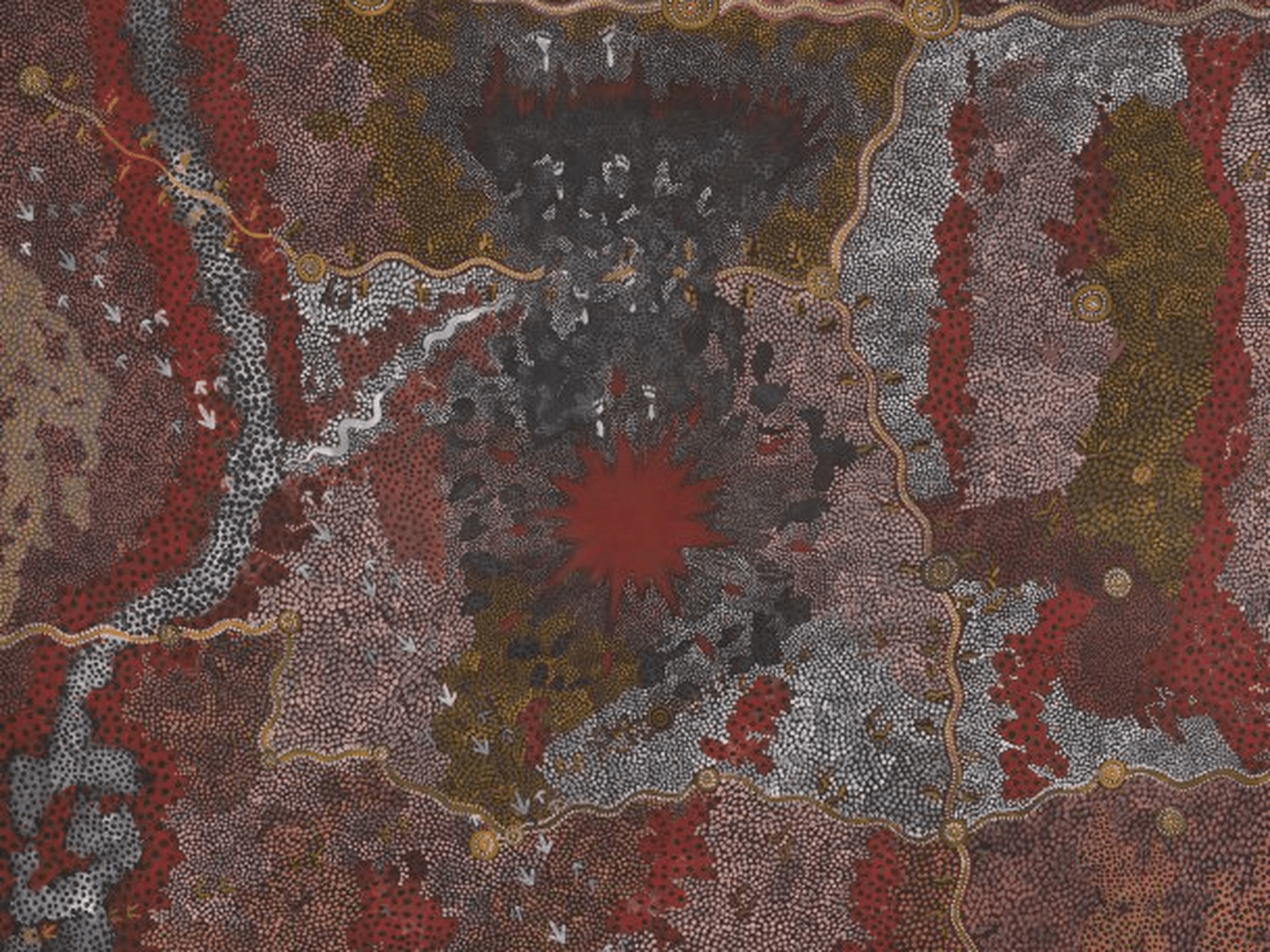
Clifford Possum Tjapaltjarri, Warlugulong, 1977. Acrylic on canvas. Art Gallery of New South Wales, Sydney. One of the founding works of the Papanya movement, the painting renders events from the Dreaming across an aerial view of country. Its extraordinary density of fine dot work functions simultaneously as surface and screen.
I see every spot within each painting as being alone yet together with all the other spots. — Damien Hirst
I have a friend, Indigenous, who has a tattoo on his left shoulder. It is the map of Australia styled from boomerang shapes and the Aboriginal flag. The same friend sent me an email, a photograph of a Canadian man with a tattoo of a maple leaf bearing the motto, 'Made in Canada'. The message was sent with contempt at the man's nationalism. But why had he the right to such contempt if he too wore a similar branding? Was this hypocrisy?
No. The difference between the hapless Canadian and his tattoo was that one was worn out of pigheadedness and the other out of resilience and defiance. One instated tautological ownership, I am what I already am, while the other laid claim to something he did not have. One mistook claim for essence, the recent creation of a state, in this case Canada, while the other asserted the essential character of his claim. One was about possession, the other about loss.
Apply that logic to the question of dots in Aboriginal art and you might say that the emotive possessiveness of most Aboriginals to the dot is not simply because it is a social identifier, but, like 'country', because their nominal ownership of it, since the invention of Aboriginal art in 1971, has always been imperfect and incomplete. Their stakes in ownership are arrived at through dispossession. Non-Indigenous people inhabit the world of images, in which ownership is arbitrary and taken for granted. For the Aboriginal the dot is talismanic; for the non-Aboriginal it is anecdotal.
This schism between talisman and anecdote is hardly new, or exclusive to Aboriginal peoples. The clearest case of the difference between ritual ownership on the one hand and sampling, or appropriation, on the other comes with tattooing, because it is the act of violent inscription upon the body. It is not only painful and permanent but either additive or constitutive of identity. Additive applies when the tattoo is obtained by choice, constitutive when it is a marker of initiation. In the latter case the word 'obtained' is too vapid, since the application of the tattoo is itself the conclusion of the ritual passage that both distinguishes a member of the group and ensures his membership of it. The tattoo is also the best exemplar for understanding the difference between sacred and ritually oriented societies, what anthropologists call 'ritually integrated' ones, and secular, rationalised ones. The difference is best seen in Japanese Samurai and Maori tattoos. These were traditionally done by hand, which made the application more painful, but to endure that pain was a key component of the warrior's mettle. Be it combat or ceremonial recognition, the warrior wore his tattoo as an aesthetic, celebratory wound.
Now it is possible to buy, for a relatively small price, what for the warrior came at considerable personal effort and risk. We can buy the trophy of a rite of passage without having to undergo its rigours. One can literally choose one's fealty to a tribe, totem, or myth. The world is yours, just not its inner substance. That tattoos are worn on the body permanently exposes the difference between the two approaches all the more. One is an outward sign of an inner, spiritual, and pathological state, in which there is a homology between self and idea; the other is an outward sign of a subjective aspiration that draws vampirically from the first condition. In short, the wearer of the modern tattoo buys into a system, and a culture, but a belonging that is entirely self-indulgent and presumptuous.
Before Aboriginal art's so-called invention at Papunya in 1971, the dots germane to that region were much larger, and were not executed on board or canvas. They were indexical signs made in the sand as part of the process of sharing stories, or of invoking totemic animals in ritual. The resultant forms, or designs, were there only as a component of the telling, which might also involve song and dance, and were removed once the ritual or storytelling event had ended. The design itself was also not art per se. Like many cultures, including the ancient Greeks, and especially those with a rich ritual awareness, Aboriginal cultures had no word for art and indeed no place for it, since the practices the Western concept associates with art were part of a much larger complex of sacred activity. By extreme contrast, what became art was now permanent, as opposed to ephemeral marks in the sand.
This radical alteration in spiritual representation immediately caused a number of objections within certain Aboriginal communities themselves. The earliest debates among elders concerned the exposure of sacred designs to non-initiated eyes, whether those of their own clan or of complete outsiders. The dots, it is often observed, as they evolved over the ensuing decade, became finer, more gauze-like, a covering layer for the secret and sacred content beneath. In acting as a protective skin, the dot assumed greater significance, not only as something for itself but as an intermediary between an iconography not to be disclosed and the outside world. Since then the dot has come to have talismanic significance for Aboriginal art and artists well beyond the boundaries of the Papunya region.
· · ·
The analogy of the tattoo is apposite to the debate over the appropriation, or misappropriation, of dots and other recognisably Aboriginal styles, a debate that has hit a high pitch. It was noticeably sparked by Lucas Grogan, a non-Indigenous artist whose finely cross-hatched boards, peopled with stylised figures smoking, drinking, and having sex, looked instantly Aboriginal until prospective buyers discovered that their maker was not. A curator resigned, galleries baulked, and the work was barred from the Sydney Art Fair. The debate was succeeded by the controversy, among some Aboriginal communities, over Del Kathryn Barton's Archibald Prize winning portrait of Hugo Weaving, a work that enjoyed a thorough drubbing over social media, particularly on Richard Bell's Facebook page. Barton's portrait is in her now familiar laboured style, and it assuages any doubt that the Archibald's love affair with caricature has dwindled. The work depicts an uncomfortable, stolid, and mildly constipated looking Weaving, interlocked with an exotic looking cat whose startled expression can possibly be attributed to the fact that its tail resembles a snake. Weaving has a garland of eucalypt leaves around him that, equally improbably, have turned the colours of deciduous trees. He sits against a sort of firmament of dotted diamonds or leaves, redolent of the classic Papunya Tula canvas, with its shimmering fields of massed earth-toned dots laid over a half-hidden geometry, except that here the colours are largely green and turquoise. The resemblance, however, is unmistakable. Barton has domesticated and 'eucaliptified' the sacred designs of the hot and remote Western Desert by rendering them in cooler colours.
Scratch a little deeper. Barton has lent her hand to the likeness of an actor who is not only non-Indigenous but was born in Ibadan, in what was then colonial Nigeria, to English parents, and has carried a British passport ever since, having reached Australia only in his teens. Some may call him an Australian actor; the passport says otherwise. It is darkly ironic that a recognisably Aboriginal style of painting, specific to the dreaming of a particular region, should be pressed into service promoting a man born under the very empire that colonised these people and subjugated them for over two hundred and twenty years. This is in no way to impugn Weaving himself. Far from it: it has nothing to do with him, his character, or his talents as an actor. But we must try to examine the issue in a broader and more objective light. After the win, Australian Vogue ran a short promotional story describing how the artist wanted to depict 'a sincere, deep, generous and creative soul'. I am unsure whether she succeeded, although she did manage to convey the registers of a gastric or some other disturbance. What is more disturbing is the word 'generous'. Again, external to any derogatory reference to Weaving himself, what we have is the very obverse of generosity: stealing from a people who continue to live in squalid and makeshift conditions, well below those of most non-Indigenous people, so as to win a prize worth seventy-five thousand dollars. It is easy to assert that the dot pattern around Barton's subject lent her painting an aura of spiritual grace, depth, and authenticity. Much as a biker gang member might get a Samurai tattoo emblazoned across his back to show that he shares the same instincts as Japan's venerable warrior priesthood, Barton availed herself of the Aboriginal dot designs to ensure her work exuded the appropriate share of legitimacy.
From here might be mounted the objection that the dots in this picture were 'just dots', much as Freud famously stated that 'sometimes a cigar is just a cigar'. Of course there is no precise delineation. It would be absurd, for example, to accuse an artist known for the use of dots, such as Yayoi Kusama, on these grounds, were she to exhibit again in Australia. But the manner in which Barton arranges hers makes the analogy all but unequivocal, and to argue that the arrangement was unintentional only courts a further objection. Inadvertently to render a swastika design at an Israeli art festival is still to be guilty of not seeing it as such and altering it accordingly. And in the case of Grogan, to appropriate Aboriginal art to such an overt extent is doubly egregious. It might have had some weight had he done so in dialogue with Indigenous artists, in the name of 'the cause', say in a work dealing with the continuing stereotypes of Aboriginal identity. But the obverse is the case. Grogan was adding to the very problem of exploitation and flagrant neglect. He did what he did because he could, and for his own personal profit. Writing in Artlink, Maurice O'Riordan observed that
Grogan himself was reputed to have had some sort of 'breakdown'. This is unfortunate, if true, but so, indeed more so, is the flagrant disregard for Aboriginal copyright, particularly when enacted consciously, as with Grogan's case, and with an apparent hunger (at least initially) for any publicity which his 'transgressions' could garner.
So while it would be naïve not to know that in our image-ready times all is available, to presume upon delicate content comes with consequences. Grogan is certainly not sensitive to the fact that art was the single biggest driving factor in giving Aboriginal people a firm place within white Australian culture. It not only gave them the self-esteem of doing something of value, but visibility in places where, in the past or even now, they would not have been permitted entry, least of all into the residences of the wealthy and powerful. The incongruities of this are deeply moot, and yet it is this compromised situation that has made Aboriginal art the single biggest artistic export, with regular auctions dedicated only to it occurring abroad, notably in New York. Non-Indigenous artists have accomplished no such feat, and are unlikely to in the near future. Robert Hughes proclaimed Aboriginal art the last great art movement of the twentieth century. Even if movements had ceased to carry the same validity by the end of that century, and even if Aboriginal art is Aboriginal art and not a movement, however obtuse or sententious the statement may be, it is worth citing for the reason that it could never plausibly apply to the art of white Australia. The dot can be understood as the stylistic sine qua non of this achievement. It is central to the Aboriginal 'brand', which is significant to Aboriginal livelihood and both the mainstay and the evolution of its identity.
One cannot help feeling some sympathy with the mockery that the collective ProppaNow level at the practice, because it is the very symptom not just of the Western-oriented invention of Aboriginal art but of its marketing and proliferation. Dot paintings are among the most popular, because they are associated with the birth of Aboriginal art and because they appear decorative. Add to that the fact that they show the visible signs of manual labour, which is always a winning component for lay purchasers of art, with Barton another beneficiary of this banal truth. The work of Tjakamarra and of other greats like Johnny Warangkula Tjupurrula has a stunning diaphanousness, a deeply seductive, hypnotic quality. But the undeniable aesthetic qualities of such work have fed an ongoing concern about Aboriginal art and its sacred content, that not only do most buyers have no knowledge of that content, nor any right to it, but their response to it is according to the work's sensuous, decorative qualities, qualities given a turbo boost of legitimacy by the gravitas of the promise of unspoiled, innocent, spiritual profundity. That the Papunya dot has now adorned a famous BMW, aeroplanes, and the Qantas uniform makes it close to a ubiquitous sign of Aboriginality. But usually, as with Michael Nelson's famous M3 BMW or the Qantas uniform, the design exists as a safe remnant, the people and their place remote from the motifs and practices that were once seamless with it.
In the words of the Indigenous artist and film-maker Janelle Evans:
Suffice to say though that when white Australians discover they have Aboriginal heritage, one of the first things they do is try to 'learn' how to be Aboriginal. This includes painting 'Aboriginal Art' using dots, 'Ooga Booga Art' (coined by ProppaNow).
It is fair to say that the dot, in the Papunya sense, assumed a far more universal importance once Aboriginal art was invented, or conceived. With the displacement from sand to canvas or board, certain motifs and styles became hypertrophied and were appropriated by other Indigenous people. The dot's closest ally in this renegotiation of objects and styles once specific to language and region is the didgeridoo. Most people in Australia, and one could possibly assert some of Indigenous heritage too, believe it to be the national instrument of Indigenous people, which it has become, although it belongs to a relatively small region of the north-eastern cape of Arnhem Land belonging to the Yolngu people. Its proper name is the yidaki; didgeridoo is the onomatopoeic pidgin.
None of this dampens the importance of the founding Papunya painters, but it does add complexity to the use of dot painting by young artists today. There is also a generation of eminent urban artists who have used dots to powerful effect, among them Gordon Bennett, Lin Onus, and Harry Wedge. Their work has helped to characterise how urban Aboriginal art is understood, namely as using certain styles and motifs in a meta-textual manner: an image or a style can carry more than one meaning, and may refer to the very ways in which Aboriginal culture is exploited or misconstrued. In this vein the dots, or in Onus's case the rarrk, the fine cross-hatching, come to assume an ironic, and conceivably also a tragic, import. To use a style not belonging to the people with whom one identifies is a strategy for reaching more than one Aboriginal people, given that subjugation is something they all share. Such artists are not profiteering from their appropriation of these motifs, since they typically have much at stake, for themselves and for the collective. There are non-Indigenous artists too, Imants Tillers and Tim Johnson among them, who have appropriated Aboriginal art, and who have done so in collaboration with, or with the permission of, certain Indigenous groups. Permissions are not universal, and some Aboriginal people feel conflicted about what they see as opportunism.
What is at stake is the core of the debate. When a non-Indigenous artist like Grogan appropriates a style so flagrantly, he is not speaking in the name of a people, nor does he carry the burden of oppression behind him. For any Aboriginal artist of quality, traditional, although these designators have shifted over the last couple of decades, and urban alike, the style, method, and content of the image come with their own degrees of responsibility and questioning. Given the disgraceful and embarrassing fact that our Indigenous peoples, as I write, are not in our national constitution, all Aboriginal art, whether or not it is sacred, is perforce also political.
This returns me to the tattoo with which I began. The tattoo of a flag in second place, worn by a member of a people yet to receive the respect they deserve, is a statement of solidarity and struggle. The tattoo of a flag, especially one from a post-colonial country, is ignorant neocon kitsch. Maybe one day, in an Australia that has finally lost its tokenism and its lip service, that has changed its national day to something other than a reminder of occupancy, violence, and enforced law, when education and recognition of the 'true' past is no longer uneven but normative and widespread, then things like dot patterns might be more freely circulated between white and black. But not yet.
· · ·
I began this with no ulterior intention, while preparing the exhibition BOMB with Blak Douglas, also known as Adam Hill, at the Aboriginal Art Museum in Utrecht. The centrepiece is a 1989 3-series BMW, of the same generation as the Michael Nelson car. We executed what we called the 'Dorian Gray's face' of the historic vehicle, not as a criticism of the artist but of the decontextualisation of Aboriginal art in general. The BMW is of a piece with the air-conditioned, white-walled display halls built for art produced in conditions of sun and dust. It is a vehicle that most Indigenous people would never buy, let alone afford, and it runs on a fuel that plays its part in despoiling their land. Ours, the 'Bomb', we painted with a huge union jack in dots. Where this places me I am unsure, but the message was pretty clear.
· · ·
References
Maurice O'Riordan, 'The (White) Elephant in the Room: Criticising Aboriginal Art', Artlink 33, no. 2 (2013).
Janelle Evans, email to the author, 30 June 2013.
Gordon Burn, 'Is Mr Death In?', in Damien Hirst, I Want to Spend the Rest of My Life Everywhere, with Everyone, One to One, Always, Forever, Now (New York: Monacelli Press, 1997), 9.
Vogue Australia, 22 March 2013.
Adam Geczy and Adam Hill, 'Aboriginal Art Diagnostic', Contemporary Art + Culture Broadsheet 40, no. 2 (2011).
